Body doubling: why working alongside someone works
The strange, well-documented effect where another person's quiet presence makes hard tasks startable — what's behind it, how to use it in person or online, and the privacy trap to avoid.
· 6 min read
There's a task you've dodged for a week. A friend comes over, sits at the other end of the table with their own laptop, says nothing — and you quietly do the task. Nobody helped. Nobody supervised. Their presence alone did something your own intentions couldn't.
That's body doubling, and it's one of the most reliable, least explained tricks in the executive-function toolkit.
What's actually going on
Nobody has a complete account, but several well-observed threads braid together:
- Gentle social stakes. Another person's presence adds just enough accountability to tip the initiation switch — without the threat level of a deadline or a boss.
- An anchor for attention.A working human nearby is a steady, low-bandwidth signal of “this is work time.” Wandering attention has something to re-sync to.
- Borrowed regulation. Calm, focused people are contagious. Co-regulation is well documented in children; adults never fully outgrow it.
- Ritual. Agreeing on a time with another person creates a start line — and start lines are precisely what unstructured solo work lacks.
Notice that none of these require the other person to do, check or even see your work. Presence is the whole mechanism.
How to use it
In person
A friend at the kitchen table, a colleague in a meeting room, a library reading room, the busy end of a café. Agree a start time and an end time; don't chat until the end. Parallel play for adults.
Online
Video-call co-working (camera on, mic off), community focus rooms, or apps with quiet co-presence. The effect survives the screen surprisingly well — what matters is a real human, really working, in your peripheral awareness.
The privacy trap
A caution about tools: co-working features are an easy excuse for surveillance. Some products log when you're “active,” store who was present with whom, or expose your focus patterns to managers. That inverts the entire point — gentle presence becomes being watched, and being watched is pressure, not support.
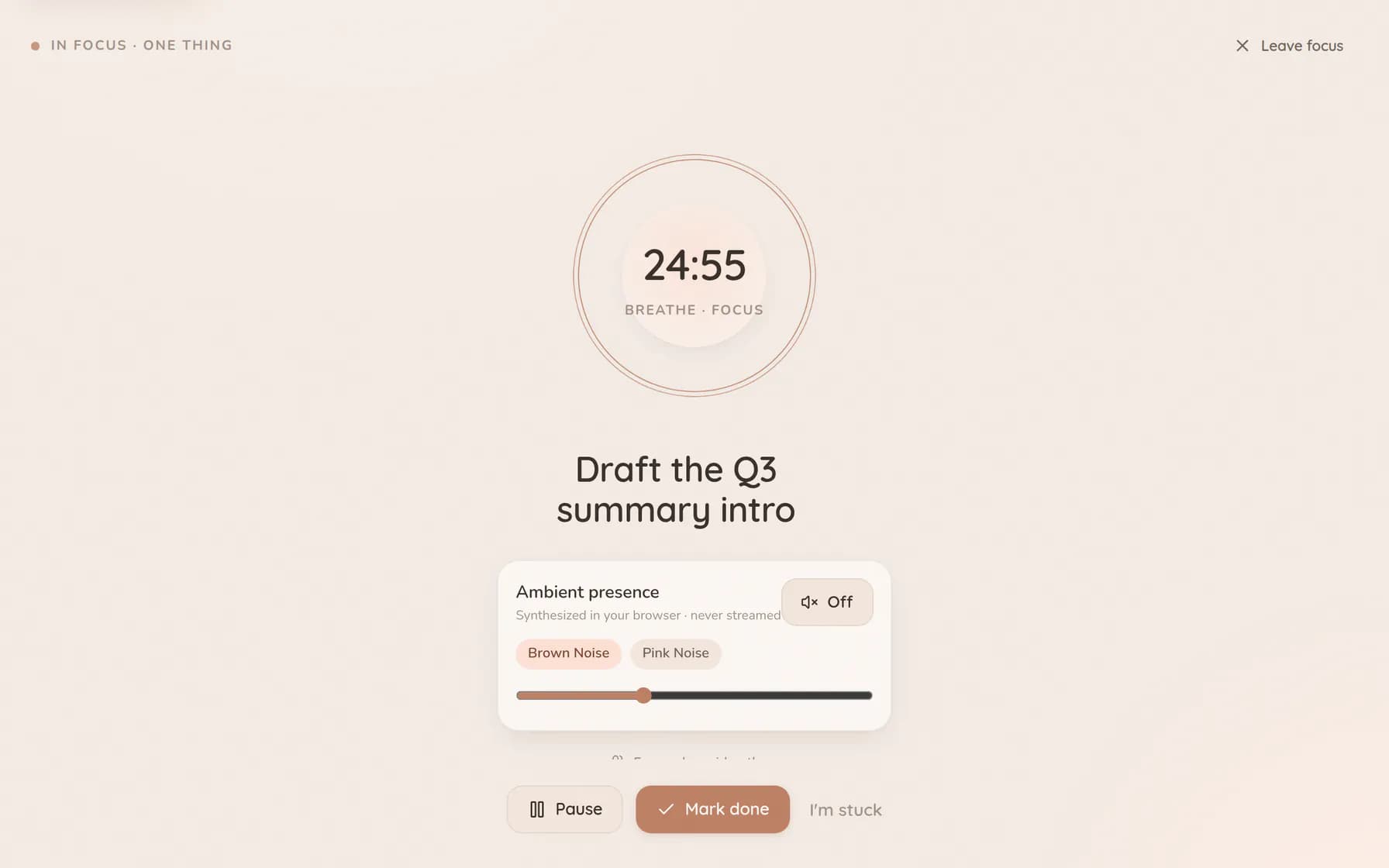
It's worth checking what any co-working tool stores. MyGlyde's focus rooms were designed against this failure mode: presence is ephemeral, processed on-device, and there is deliberately no server-side record of who was in a room or when you looked away. You get the human; nobody gets the log.
Start smaller than you think
Body doubling needs no app at all: text a friend “working 9:30–10:30, join me on a call?” and try one hour of silent parallel work. If the dodged task finally moves, you've learned something cheap and important about how your initiation system likes to be started.