Why starting feels impossible: task paralysis, explained
Task paralysis isn't laziness — it's a traffic jam in the brain's initiation system. What's actually happening, why 'just start' advice fails, and the smallest-first-move technique that works.
· 6 min read
You know the state. The task is important. You have time. You even want to do it. And yet you're alphabetizing the spice rack, re-reading the same news story, doing anything that isn't the thing. Hours pass, dread compounds, and eventually you conclude something unflattering about your character.
That conclusion is wrong, and it's worth being precise about why.
Paralysis is an initiation problem, not a motivation problem
Getting started is its own cognitive operation — separate from wanting to, knowing how to, or being able to do the task itself. Psychologists file it under executive function: the brain's management layer that sequences actions, estimates time and flips the switch from intending to doing. When that switch is sticky — which it is for almost everyone under stress, and chronically for many people with ADHD — you get the signature experience of task paralysis: motivation fully present, action fully absent.
This is why “just start” and “you need more discipline” advice fails so reliably. It aims at motivation, which was never the missing piece. You can't willpower a traffic jam.
Why big tasks jam the system
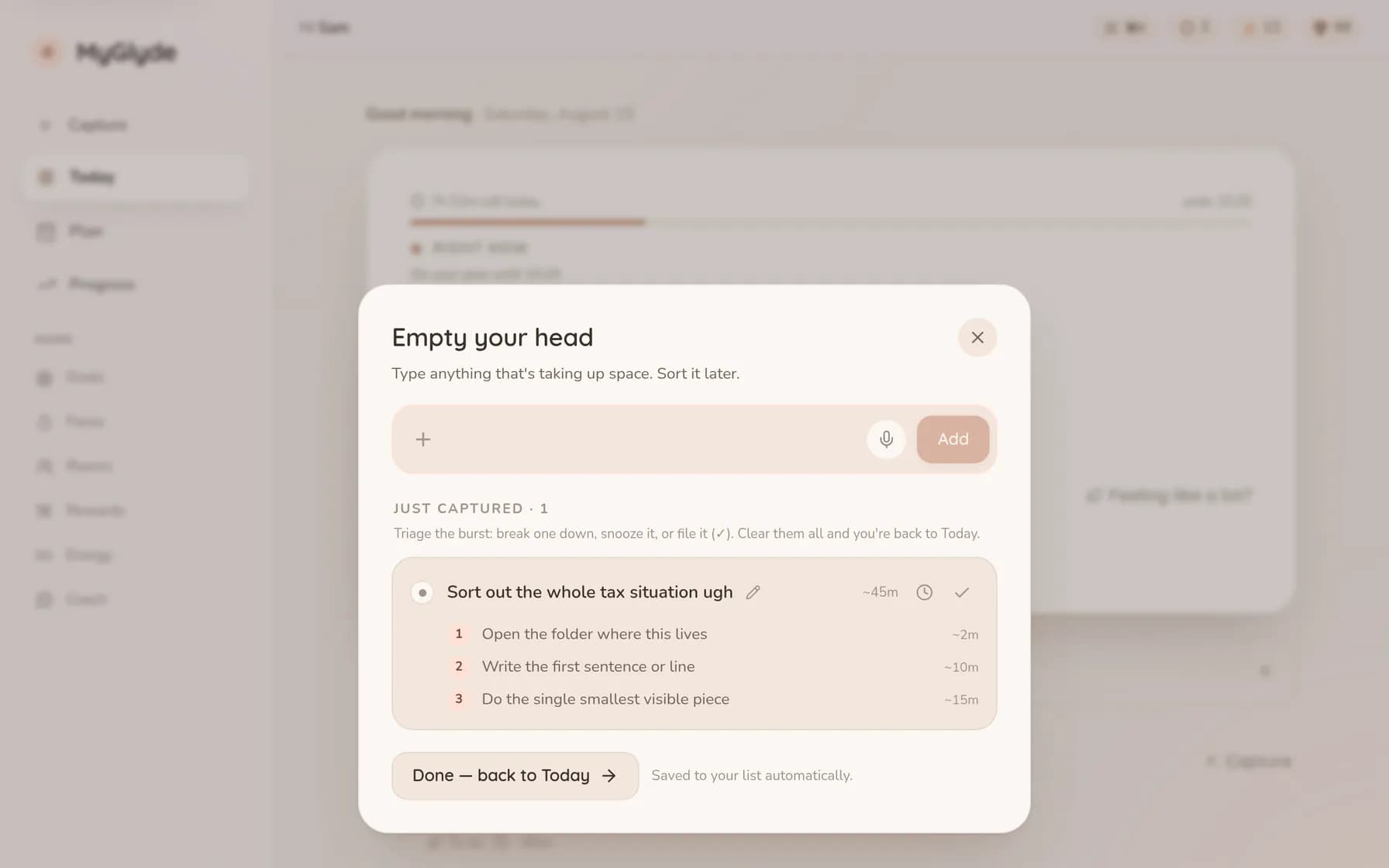
Initiation stalls hardest on tasks that are vague (“sort out taxes” — sort what, exactly?), large (no visible edge to grab), or emotionally loaded (the task carries judgment — a performance review, an overdue reply, anything with an audience). The brain, asked to open a door with no handle, quietly proposes the spice rack instead. That's not weakness; it's the system doing exactly what it does when an action has no findable first step.
The smallest-first-move technique
The fix is mechanical, not moral: shrink the first move until it's smaller than the resistance.
- Name the real task out loud, as messily as it lives in your head.
- Ask: “what is the first physicalaction?” Not “do taxes” — “find last year's return in my email.” If it takes more than about two minutes, it's still too big. Halve it again.
- Do only that move. Genuinely only that. Stopping after it is a success, not a cop-out — most of the time, though, motion continues on its own, because initiation was the only broken part.
Two minutes of real contact with the task nearly always beats thirty minutes of planning to have contact with the task.
When it isn't laziness (it almost never is)
If this pattern runs your weeks rather than your worst afternoons — especially alongside time blindness, lost objects and a graveyard of abandoned systems — it may be worth learning about executive function more broadly or talking to a professional. Task paralysis is one of the most common ADHD experiences, and reframing it as mechanics rather than character is frequently the single most useful step.
And if you want the mechanics done for you: this is precisely what MyGlyde's Magic Breakdown automates — you type the fog bank, it hands back the three smallest first moves.