How to break down overwhelming tasks (a concrete method)
The three-first-moves method: how to turn a looming, vague project into actions you can start in the next two minutes — with worked examples and the reason three beats ten.
· 7 min read
Every productivity system eventually says “break big tasks into smaller ones” and then wanders off, as if the breaking-down part were obvious. It isn't. Done badly, decomposition produces a twenty-item checklist that's more paralyzing than the original task. Here's a method that reliably produces starts.
The three-first-moves method
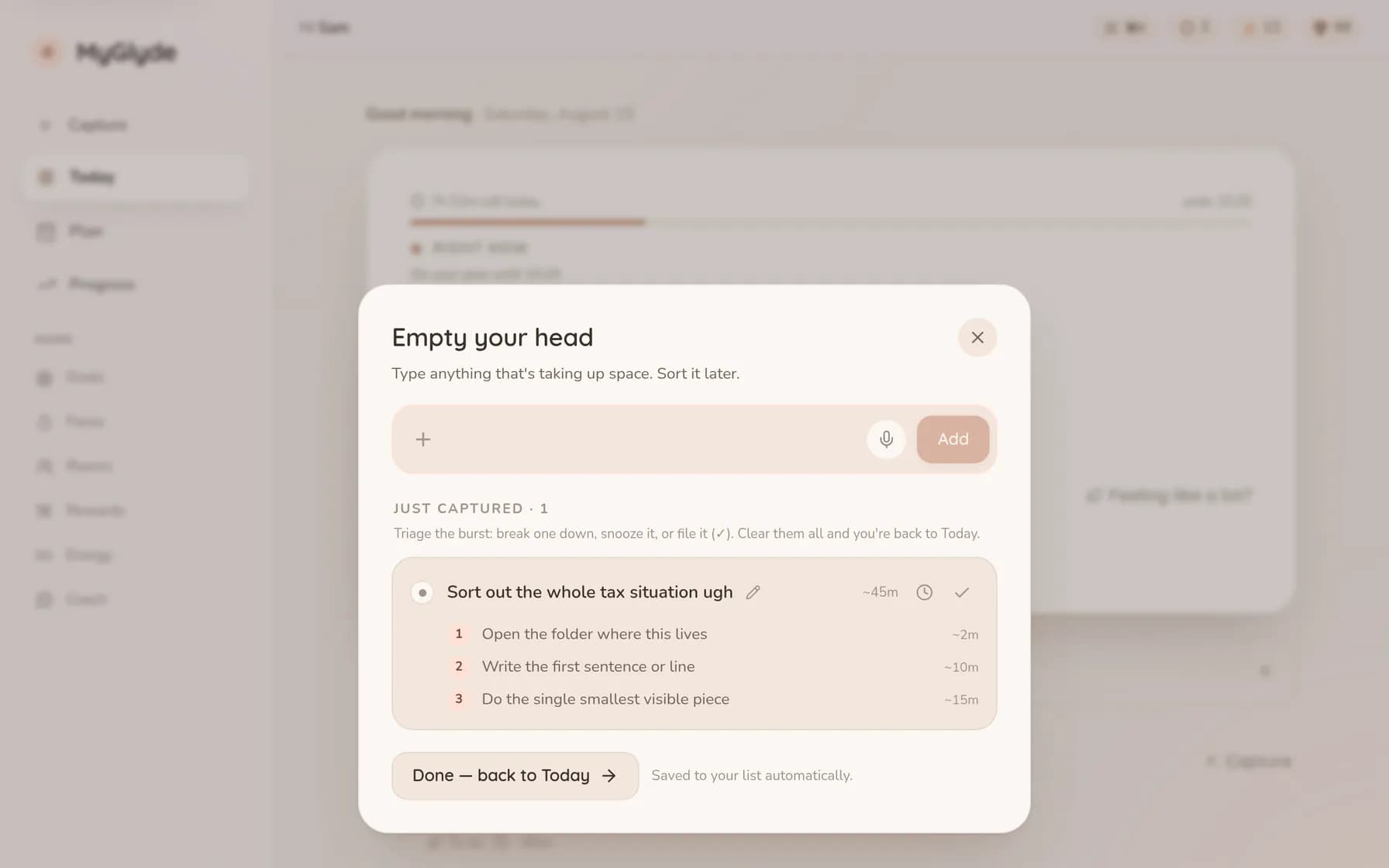
Don't map the whole project. Identify only the first three physical moves — concrete actions involving your hands, your keyboard or your voice — and ignore everything after them.
- Write the task as it actually haunts you. “Deal with the tax return.” Vague is fine; honest is essential.
- Ask “what would I literally do first?” and keep answering until the action is physical and takes under ten minutes. “Gather documents” is a category. “Search my email for ‘P60’” is a move.
- Stop at three. Write them down where you'll work, and hide the rest of the project from view.
Worked example: the tax return
- Search email for “P60” and drop results in a folder — 5 min
- Open last year's return and skim what sections it had — 5 min
- Write one list of what's missing this year — 5 min
Notice what's absent: nothing about completing the return. Fifteen minutes of first moves converts “the tax thing” from a dread-object into a known quantity with edges — and known quantities get finished.
Worked example: the job application
- Re-read the job listing and highlight three phrases — 5 min
- Open your CV and rename the file for this role — 2 min
- Draft one sentence: why this role, this year — 5 min
Why three, not ten
A full decomposition front-loads hundreds of decisions — ordering, granularity, completeness — before any work happens, and decisions are exactly what an overloaded executive system can't spare. Three moves need no ordering debate and no completeness. They also exploit a quiet truth: after three real moves, you are inside the task, and the next steps name themselves from in there. The plan you'd have written from outside was mostly fiction anyway.
Let something else do the decomposing
The method's only tax is that on the worst days, even finding three moves feels like work. That step automates well: Magic Breakdown in MyGlyde takes the haunted phrase and returns the first few moves, sized in minutes, ready to run inside a focus sprint. The thinking stays yours; the door-handle gets installed for you.