Time blindness: why 'five more minutes' is never five minutes
Some people feel time passing; some people don't. What time blindness actually is, why clocks alone don't fix it, and the externalising tricks that make a duration something you can see.
· 6 min read
You sit down to check one thing before dinner. You look up and it is quarter past nine. Nothing dramatic happened in between — you were there the whole time, awake and conscious, and yet three hours passed without registering.
Or the other version: a task you were certain would take twenty minutes takes two hours, again, and it takes two hours the next time as well, and you estimate twenty minutes for it a third time. Being wrong doesn’t seem to update the estimate.
Both are time blindness — a difficulty perceiving duration as it passes, and projecting it forward. It is well described in ADHD, appears in other neurodivergent profiles, and shows up in anyone who is exhausted or deeply absorbed. It is not a character flaw, and it is remarkably resistant to being told to try harder.
What it actually is
Most people carry a rough internal sense of duration. Ask them how long they have been reading and they will be roughly right without checking. That sense is doing quiet work all day: it tells you to wrap up, that you are running late, that this has gone on longer than intended.
When that sense is unreliable, time becomes information you have to go and fetch rather than something you feel. And fetching requires remembering to fetch — which is precisely the thing absorption prevents. So the clock is available, visible, on the wall, and completely irrelevant, because nothing prompts you to consult it.
This is why “just watch the clock” fails as advice. The failure isn’t missing information. It’s a missing prompt to seek the information.
The two directions it breaks
Backwards — time already spent is invisible. Hours vanish into an absorbing task and surface only when something external interrupts, usually a person or a hunger pang. There is no internal alarm.
Forwards— time not yet spent can’t be estimated. Every task is quoted at its theoretical minimum: the version with no interruptions, no setup, no finding the file, no going back for the bit you forgot. Then it takes three times that, which is not a surprise to anyone except the person doing the estimating.
The forwards version produces a specific, painful pattern: chronic lateness accompanied by real effort not to be late. You left with what genuinely felt like enough time. The feeling was simply not calibrated.
Why the clock isn’t enough
A digital clock reads 16:42. To use that, you must know when you started, do the subtraction, and compare against a plan — three operations of working memory, at the exact moment you are absorbed in something else. It is technically available and practically useless.
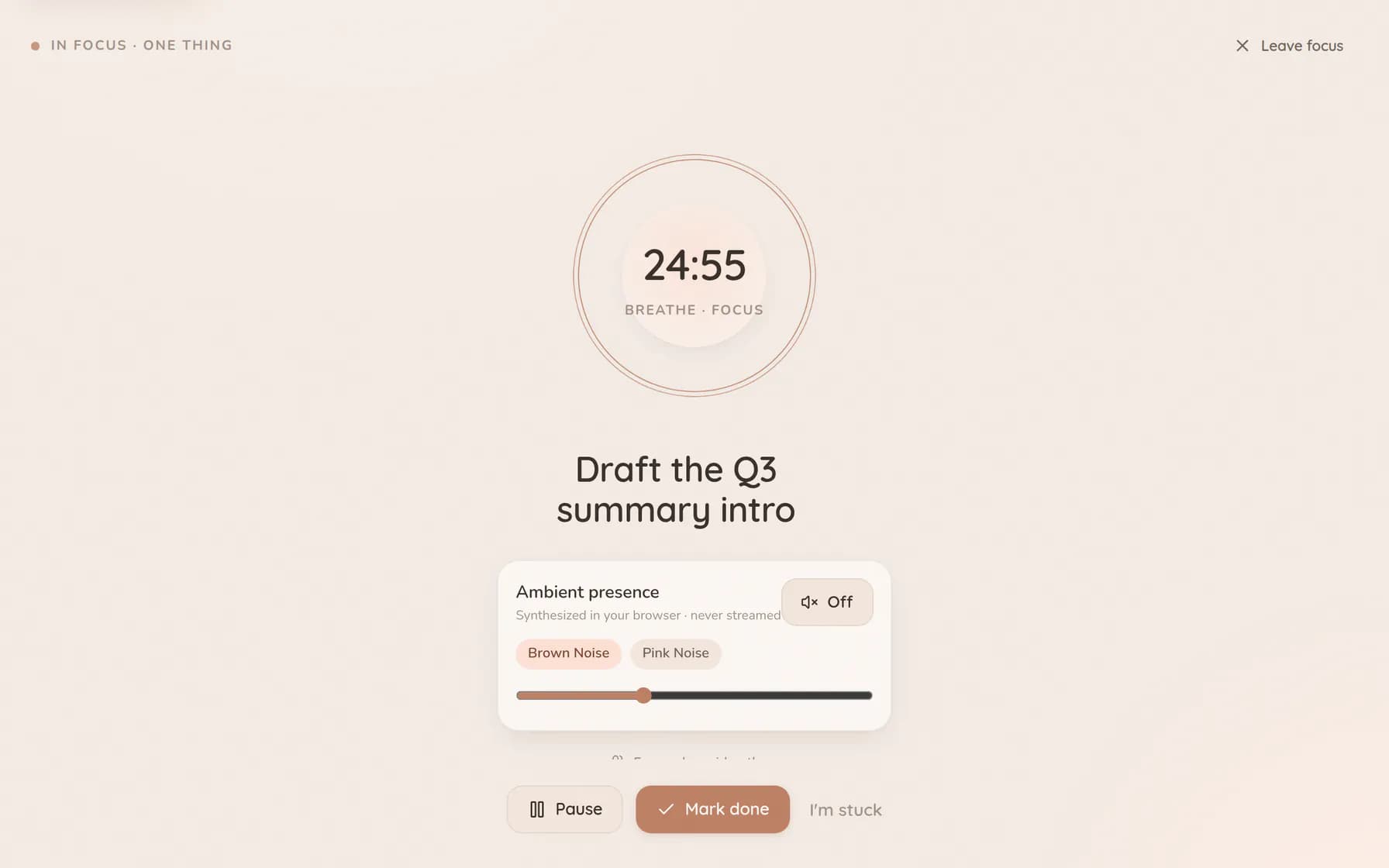
What works is making duration continuously perceptible instead of numerically retrievable. Something that shrinks, empties, drains or moves in your peripheral vision, so that noticing takes no deliberate act at all.
Six things that genuinely help
- Analogue over digital. A physical timer with a coloured wedge that disappears, or a visual timer app, beats a number. You read the remaining time without deciding to.
- Alarms for the start, not just the end. Most people set an alarm for when they must leave. Set one for when the preparation must begin — the leaving alarm arrives at the exact moment it is already too late.
- Log actual durations for two weeks.Not to be disciplined — to build a reference table. “Weekly report: actually 95 minutes, four times running.” You are substituting data for a sense you don’t have, which is exactly the right trade.
- Estimate, then multiply. Whatever your instinct says, double it. If you are consistently out by three, use three. It feels absurd and it is far more accurate than your feeling.
- Anchor to events, not clock times.“After I make coffee” is a more reliable trigger than “at 10:30”, because it doesn’t require noticing a moment pass.
- Put a hard edge on absorbing activities. The tasks that swallow hours need an external boundary — a timer that ends the session, a calendar event after it, someone expecting you.
The estimate that never updates
One specific trap deserves its own mention, because it survives years of contrary evidence.
You estimate a task at thirty minutes. It takes ninety. Next time, you estimate thirty again. This isn’t stupidity — it’s that the estimate is generated from the ideaof the task, which is clean and linear, while the ninety minutes was made of setup, interruption, a detour and a correction, none of which are part of the idea. The memory of the overrun doesn’t attach to the concept.
The only reliable fix is external: write down what things actually took, and consult the record instead of your instinct. Tools that quietly learn your real durations and adjust future estimates are doing this for you, which is the entire point of externalising — the management layer has less to carry.
What it doesn’t fix
Visible time makes duration perceptible. It does not make an aversive task appealing, and it will not survive genuine exhaustion — on a badly slept day the timer becomes wallpaper within minutes. It also won’t help if the underlying problem is that you have agreed to more than fits in the week; that is arithmetic, and no perception aid changes arithmetic.
And to say it plainly: this describes an experience, not a diagnosis. Time blindness is a feature of several very different conditions, and if it is genuinely disrupting your work or relationships, that is worth raising with a clinician rather than solving with a timer.
For everything else, the principle is simple and it holds: if you can’t feel time, put it somewhere you can see it.