Executive function, explained: the eight skills behind getting anything done
Initiation, working memory, time perception, emotional regulation — the eight mental skills that turn an intention into a finished thing, what it feels like when each one stalls, and what to do about it.
· 11 min read
There is a particular kind of stuck that has nothing to do with not caring. You know what the task is. You know it matters. You may even know exactly how to do it. And still the gap between knowing and doing sits there, wide and unbridgeable, while the afternoon disappears.
That gap has a name. Executive functionis the umbrella term for the mental skills that convert an intention into a finished thing — the management layer sitting above knowledge and ability. When people say “I know what to do, I just can’t make myself do it”, they are describing an executive function problem, and it is a genuinely different problem from not knowing or not caring.
This page is the long version: the eight skills, what it feels like from the inside when each one stalls, and what actually helps in each case. It is deliberately mechanism-first, because the single most common reason productivity advice fails is that it treats one cause and you have a different one.
What executive function actually is
Think of a competent operations manager. They don’t do the work. They decide what happens first, hold the plan in mind, notice when it isn’t working, stop the thing that isn’t working, and keep everyone steady when it goes wrong. Executive function is that manager, running inside you, mostly out of sight.
It isn’t a single ability and it isn’t a personality trait. It’s a cluster of related skills, they vary independently, and every one of them is degraded by tiredness, stress, illness, hunger and grief. This is why a person can be superb at their job for years and then, for six months, be unable to answer an email. Nothing about them changed except the management layer’s available capacity.
In ADHD, several of these skills run persistently below where the rest of a person’s abilities would predict — which is why the experience is so frequently described as knowing better and doing worse, and why willpower framing lands as an insult rather than advice. But you do not need a diagnosis to have an executive function bottleneck. Everyone has one under enough load.
The eight skills
1. Initiation — getting the first move out
The skill of converting a decision into a physical action. This is the one people mistake for laziness most often, and it fails in a very specific way: the harder you stare at the task, the less startable it becomes, because staring at it produces detail, detail produces options, and options produce a stall.
What helps:shrink the first move until it is embarrassingly small — not “write the report” but “open the document and type the title”. The goal is not progress; it is to end the state of not-having-started, which is the expensive state. We wrote about this at length in task paralysis and gave the method in how to break down overwhelming tasks.
2. Working memory — holding the plan while you use it
The mental whiteboard. It holds the four things you need in mind simultaneously to do the fifth. When it is small or leaky you walk into a room and lose the reason, you re-read the same paragraph three times, you finish a call unable to reconstruct what you agreed.
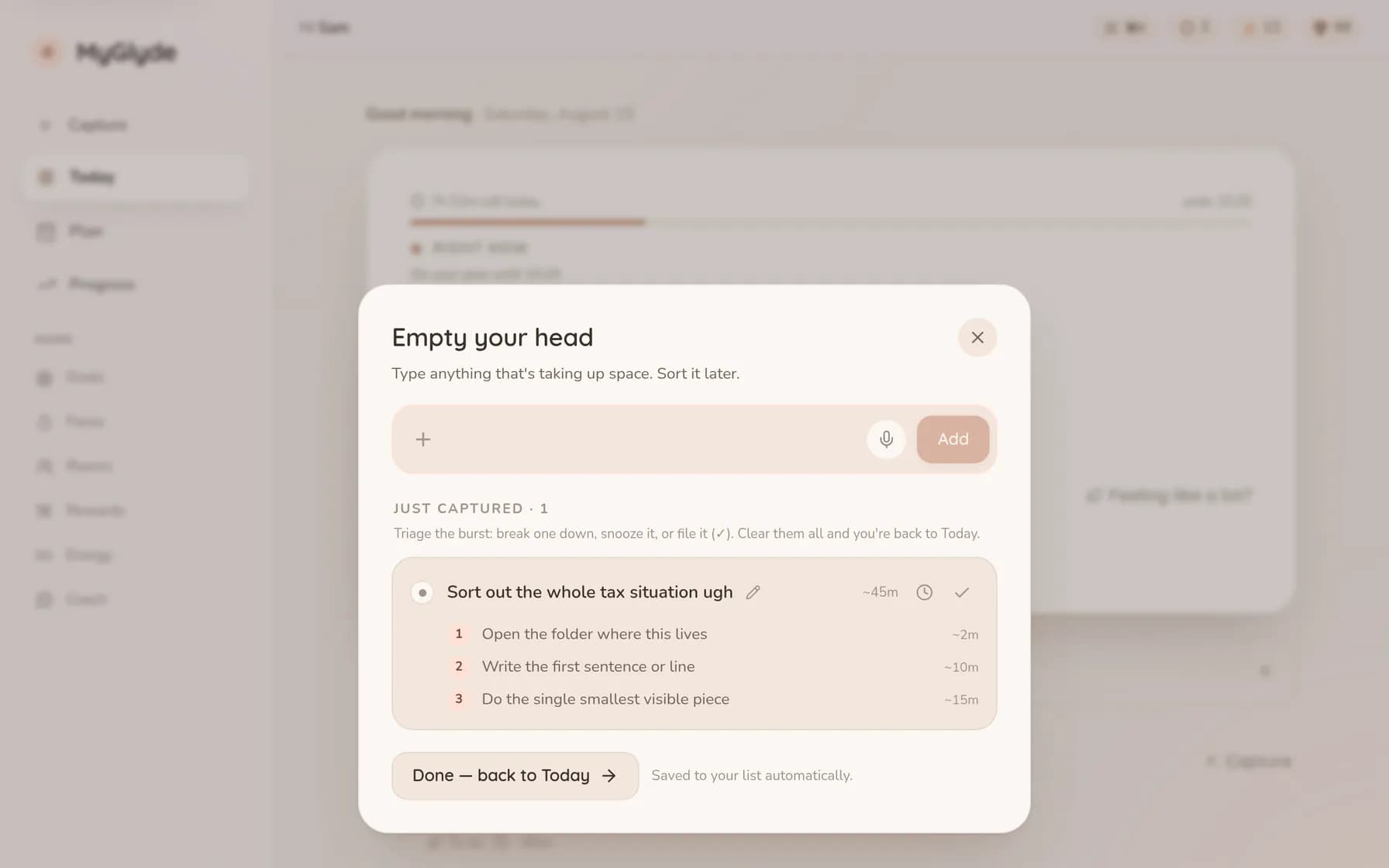
What helps:stop paying rent on it. Anything held in your head is occupying a scarce resource, so write it down the moment it appears — not later, when you have time, because the whole problem is that it won’t survive until later. A capture habit is worth more than a filing system.
3. Time perception — feeling duration pass
Some people have a reliable internal sense of how long twenty minutes is. Some people genuinely do not, and no amount of being told to “watch the clock” installs one, because the failure is in the feeling, not the information.
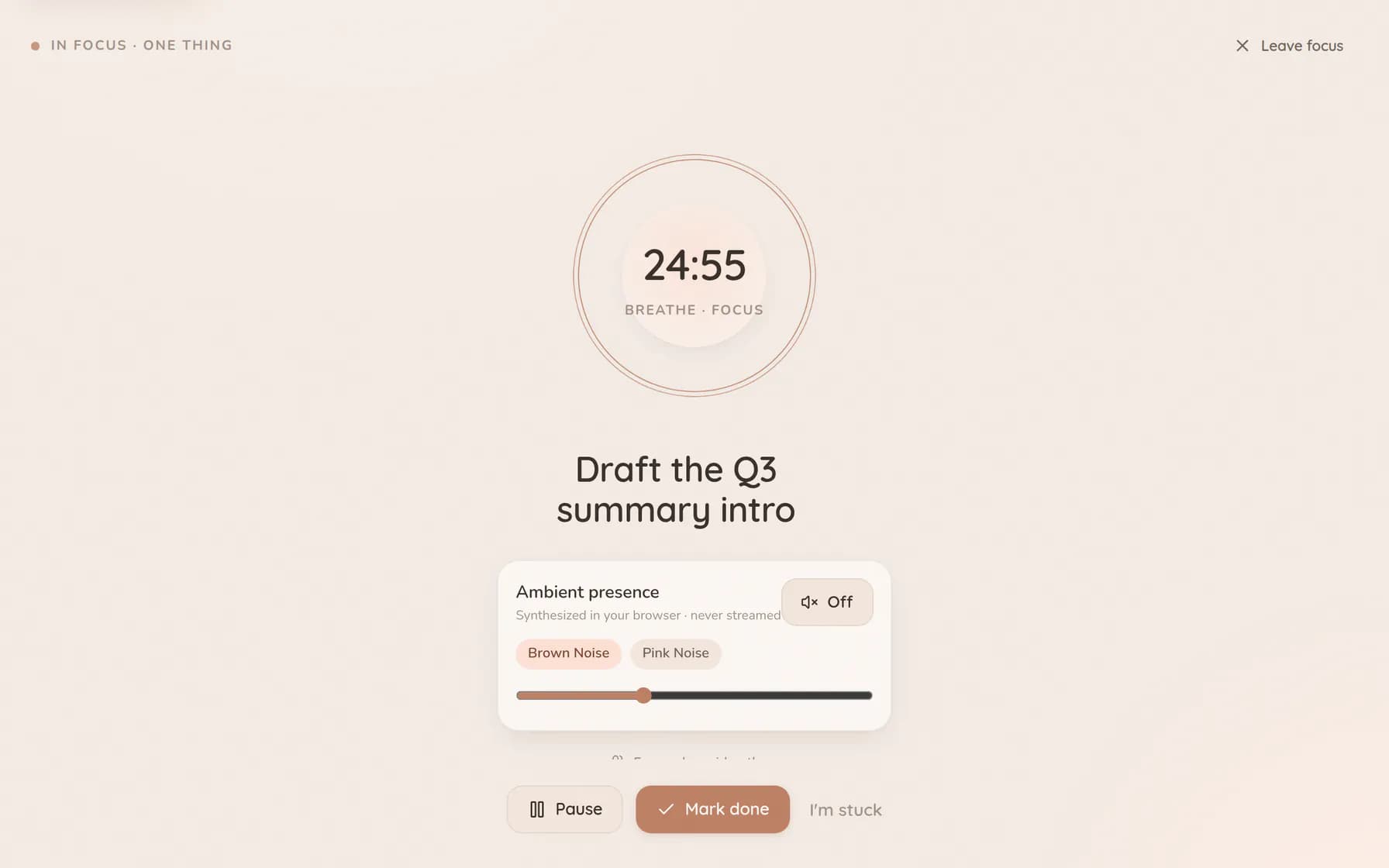
What helps: make duration visible rather than numerical — a shrinking bar, a physical timer, a ring that empties. Full treatment in time blindness.
4. Prioritisation — deciding what matters most, now
Not making a list. Ranking it, and being able to feel the difference between items. When this stalls, everything arrives at the same urgency: the tax return and the unanswered text from a friend have identical weight, which is exhausting and paralysing in equal measure.
What helps: stop trying to rank the whole list. Compare two items at a time, or use a rule that decides for you — deadline first, or smallest first, or whatever the person waiting is waiting for. A mediocre rule you actually apply beats an optimal ranking you never finish.
5. Sustained attention — staying with something boring
Attention is not a single tap that runs at a chosen pressure. It is heavily modulated by interest, novelty, urgency and difficulty — which is why the same person can lose six hours to something absorbing and cannot hold ninety seconds on an expenses form. The capacity is real; its distribution is uneven.
What helps: borrow interest from somewhere else. Sprints with a visible end, a body double, music that stays in the background, doing the boring thing beside someone doing their own boring thing. See body doubling and six causes that aren’t willpower.
6. Task switching — changing gear without stalling
Moving cleanly from one activity to another. Two failure modes, and they look opposite: some people cannot leave a task once absorbed (the stuck-in-gear version), while others fragment at the smallest interruption and cannot get back. Both are switching costs; they just land at different ends.
What helps: plan the transition, not just the work. Leave yourself a note about the next physical action before you stop — the re-entry cost is where the time actually goes, and a single sentence at the end of a session can save twenty minutes at the start of the next.
7. Emotional regulation — staying steady when it goes wrong
The least-discussed executive skill and often the decisive one. A rejected proposal, a critical comment, a task that turned out harder than expected — the emotional spike itself isn’t the problem. The problem is that a big spike takes the management layer offline for the rest of the day, and then nothing else on the list happens either.
What helps:design for the bad day in advance, while you are calm. A shorter list you are allowed to fall back to, a pre-agreed minimum, a system that doesn’t punish you the morning after — this is the entire argument in streaks without shame.
8. Self-monitoring — noticing how it’s going
The ability to step outside the work and assess it: am I actually making progress, is this taking longer than I thought, is this still the right task? Without it you can spend a full afternoon polishing something that didn’t need polishing, and feel busy the entire time.
What helps: a scheduled outside view, because you cannot rely on noticing from the inside. A ten-minute weekly checkpoint does most of the work — here is the script.
Why generic productivity advice keeps failing you
Look at the eight, and the reason becomes obvious: most advice is a fix for one specific skill, sold as a fix for all of them.
- Time blocking is a prioritisation and time-perception aid. Give it to someone whose bottleneck is initiation and they will produce a beautiful calendar and start none of it.
- Inbox zero is a working-memory aid. Give it to someone whose bottleneck is emotional regulation and it becomes one more surface to fail at.
- Pomodoro is a sustained-attention and time-perception aid. It does nothing for task switching, and for a person who stalls at re-entry the interruptions actively hurt.
- “Eat the frog” assumes initiation works and only prioritisation is missing. If initiation is your bottleneck, this advice puts the hardest possible starting cost first thing in the morning.
None of these are bad. They are treatments for particular failures, and the reason you have a graveyard of abandoned systems is probably not inconsistency. It is that you have been prescribed for the wrong one, repeatedly, by people who assumed their bottleneck was yours.
Find your bottleneck
Take a task you have been avoiding and ask where, precisely, it stops. Not “why am I like this” — where does the sequence break?
- Can’t decide whether to do it at all → prioritisation
- Decided, but the first physical action never happens → initiation
- Started, then lost the thread of what you were doing → working memory
- Started, then drifted somewhere more interesting → sustained attention
- Meant to do it at 2pm, looked up and it was 6pm → time perception
- Got interrupted and never came back → task switching
- One piece of bad news ended the working day → emotional regulation
- Worked all day on it and it turned out to be the wrong thing → self-monitoring
Most people have two or three that recur, and the recurrence is the useful signal. Fix the one that shows up most and a surprising amount of the rest resolves itself, because these skills are load-bearing for each other: nothing you never started can be monitored, and nothing you can’t hold in mind can be prioritised.
The honest limits
Three things worth saying plainly.
Externalising is not cheating, and it is not a cure. Writing things down, making time visible, having software hold the plan — these move load off the management layer, which is exactly what you want. They do not increase its capacity. On a bad week you will still have a bad week; you will just have a smaller crater.
Capacity is physiological before it is behavioural. Sleep, food, movement and stress move executive function more than any technique in this article. If you are running on five hours’ sleep and coffee, no system will hold, and the system is not the thing to fix first.
This is a description, not a diagnosis. Persistent, life-limiting executive function difficulty is worth discussing with a clinician — ADHD, autism, depression, anxiety, long COVID, thyroid problems and chronic stress all affect these skills, and they need different responses. Nothing here is medical advice, and no app can tell you which one you have.
What to do with this
Pick the single bottleneck from the list above that showed up most this month. Choose one externalising change that targets it specifically — one, not a new system. Run it for two weeks, and judge it on your worst day rather than your best, because the best day was never the problem.
That is the whole method. It is unglamorous, it doesn’t come with a productivity identity attached, and it works considerably better than another rebuild.