The 10-minute weekly reset
A four-step script for the weekly review that people with a full week actually finish: close the loops, pick three, protect the time, choose the drop. No inbox-zero, no perfect system.
· 5 min read
The classic weekly review takes ninety minutes, has eleven steps, and assumes you will process every inbox to zero. Almost nobody with a full week sustains it past a month, and then the failure to do it becomes one more thing to feel bad about.
This is the version that survives. Four steps, ten minutes, same time every week. It does not organise your life. It answers one question — what am I actually doing this week? — which turns out to be most of the value.
Before you start
Pick a fixed slot and defend it: Friday afternoon, Sunday evening, Monday morning with coffee. The specific time matters far less than it being the same one, because a floating appointment requires a decision each week, and a decision is where habits die.
Set a ten-minute timer. This is not a suggestion — the timer is what stops the reset from expanding into a rebuild, which is the failure mode that ends most review habits. Ten minutes, then stop, even mid-thought.
Step 1 — Close the loops (3 minutes)
Open wherever tasks live and go through last week only. Every item gets one of four fates, quickly:
- Done — tick it, even if you did it without ever adding it. Especially then.
- Still matters — leave it, no re-planning.
- Doesn’t matter any more — delete it. This is the step people skip, and it is the one doing the work.
- Been there three weeks untouched— either shrink it to a two-minute first move or delete it. Something you have carried three weeks is not a task; it is a decision you haven’t made.
Do not sort, tag or reschedule. Four fates, fast.
Step 2 — Pick three (3 minutes)
Name the three things that, if done, would make this a good week. Write them somewhere you will see them. Three — not five, not ten.
Three is chosen deliberately: it is small enough to hold in your head without consulting anything, and small enough that you will actually commit rather than hedge. A list of ten priorities is a list of no priorities, and you already know which three they are.
Then, for each one, write the first physical action— the thing a body does. Not “sort out the budget” but “open last month’s spreadsheet”. This one habit removes most of Monday’s friction, and it is the same move described in how to break down overwhelming tasks.
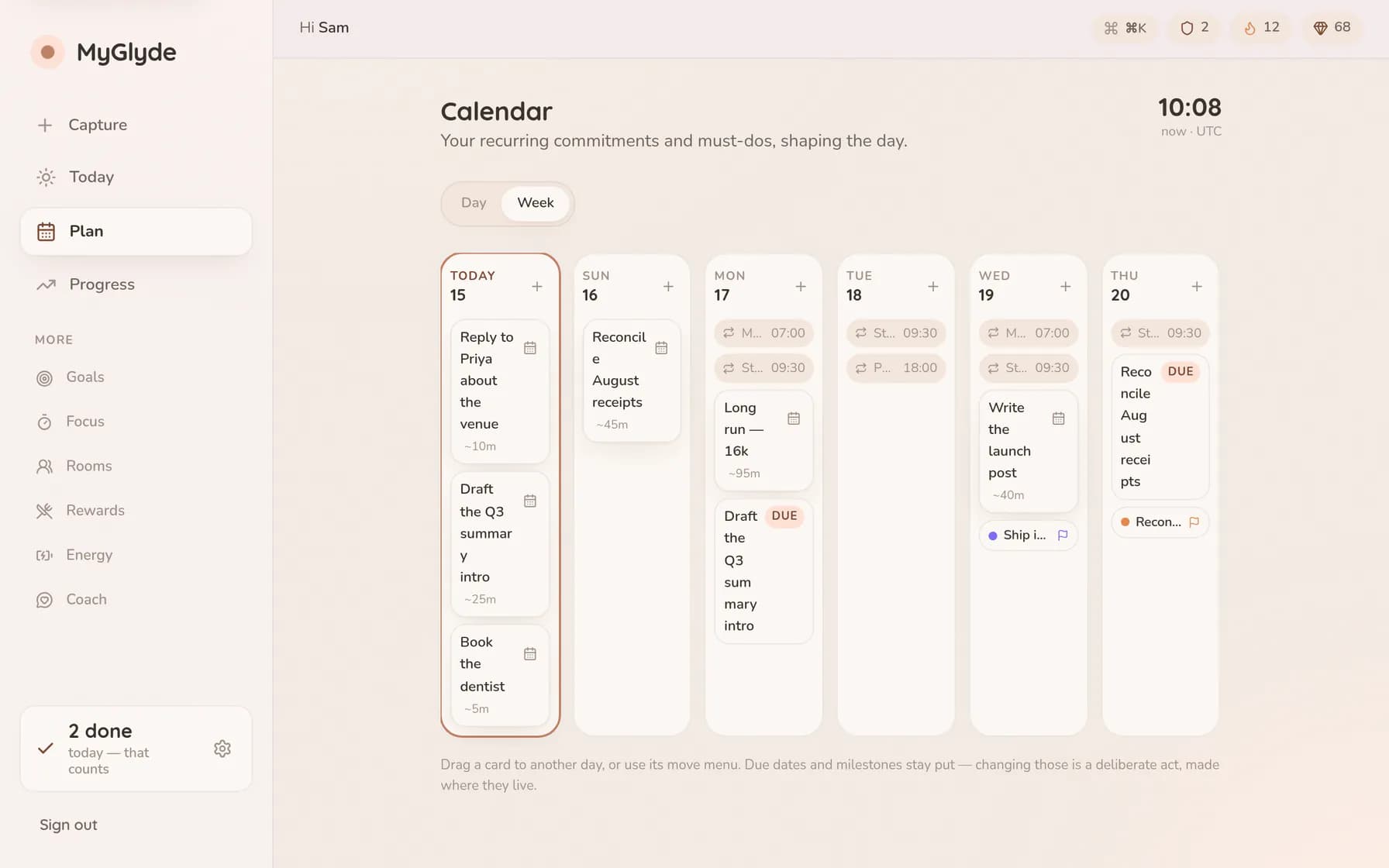
Step 3 — Protect the time (2 minutes)
Look at the calendar and ask one question: where does each of the three physically fit?
Not a full time-blocked schedule — just confirm the hours exist. If Wednesday is meetings from nine to five, the deep work isn’t happening on Wednesday, and it is much better to know that now than to discover it at 4pm feeling like a failure. Put a block in for whichever of the three is largest. One block, not three.
This step is where the week stops being aspirational. Most weeks go wrong because we planned against the week we wished we had.
Step 4 — Choose the drop (2 minutes)
The step nobody includes, and the reason this version survives. Decide now, while calm: if the week goes badly, which of the three gets dropped?
Something will go wrong — it does most weeks. If you haven’t decided in advance, Thursday-you makes that call under pressure, and Thursday-you drops whatever feels hardest rather than whatever matters least. Those are rarely the same thing.
Pre-deciding the drop also converts a bad week from a failure into a plan executing as designed, which sounds like a semantic trick and turns out to matter a great deal for whether you show up next Monday. It is the same principle as a streak that bends instead of breaking.
The whole script
- Close the loops — done, keep, delete, or shrink.
- Pick three — plus the first physical action for each.
- Protect the time — confirm the hours exist; block the biggest one.
- Choose the drop — decide now what goes if the week turns.
If you miss a week
Do not do a double reset to catch up, and do not review the missed week. Start from today. The reset is about the week ahead; last week is already spent, and auditing it produces guilt rather than information.
And if ten minutes is too much on a given Sunday, do step 2 alone. Pick three. That is the floor — the version that keeps the habit alive through a bad month, which is the only thing a weekly habit really has to do. The rest of the review is a luxury; knowing your three is not.